Nobody's Paid to Put It Down
The phone is now work, and the people who set the norms are paid by them. Why top-down advice keeps failing, and why the answer starts at the kitchen table.
I spend a lot of time on one question. After a decade of warnings from teachers, doctors, neuroscientists and politicians, why has so little changed in how we live with our phones?
We know the usual answers. We've heard them enough times now. The attention economy is built to keep us there, and the design is deliberate and effective. There are also the social forces I've written about in earlier pieces that hold us in place: the complicity bargain, pluralistic ignorance and the permission cascade at the dinner table.
I think there is another force hiding in plain sight. It isn't psychological, it's economic. And it isn't concentrated in Silicon Valley. It's spread across millions of ordinary livelihoods the world over.
The phone is now work
Start with the version that touches almost everyone. For most of us, the phone is no longer a distraction we choose. It's infrastructure we depend on.
Two-thirds of UK workers say they participate in work-related communications outside of their working hours. And a third of workers say their employer contacts them on their personal phone outside office hours, despite using a separate device for work.
I see it in hospitality every week. The rota, the shift swaps and the “can anyone cover tonight?” message all arrive on WhatsApp. Small businesses live or die on Instagram. Around 4.7m working-age adults do platform work through an app at least once a week. Parents run school life through apps.
So when someone says “just put it down”, the real reply for a lot of people is: I can't afford to. This is the utility ring. The phone sits at the centre of so much of what we need that leaving it was never an option.
The people who set the norms are paid by them
Utility explains why we can't leave. It doesn't explain why the culture keeps pulling the other way. For that, look at who sets the norms.
Mobile represents 71 per cent of UK digital ad spend, £15.1 billion in the first half of this year alone. UK creator revenue is rising 26% to £1.217bn in 2026, and 93% of UK brands and agencies expect to increase their influencer marketing spending. Advertising supports 1.7 million UK jobs, 5% of all UK employment.
Now think about who has the loudest voice in how we live with our phones: creators, marketers, media and brands. They're the people whose routines we copy and whose posts set the tone. Almost all of them earn more when we spend more time on our phones.
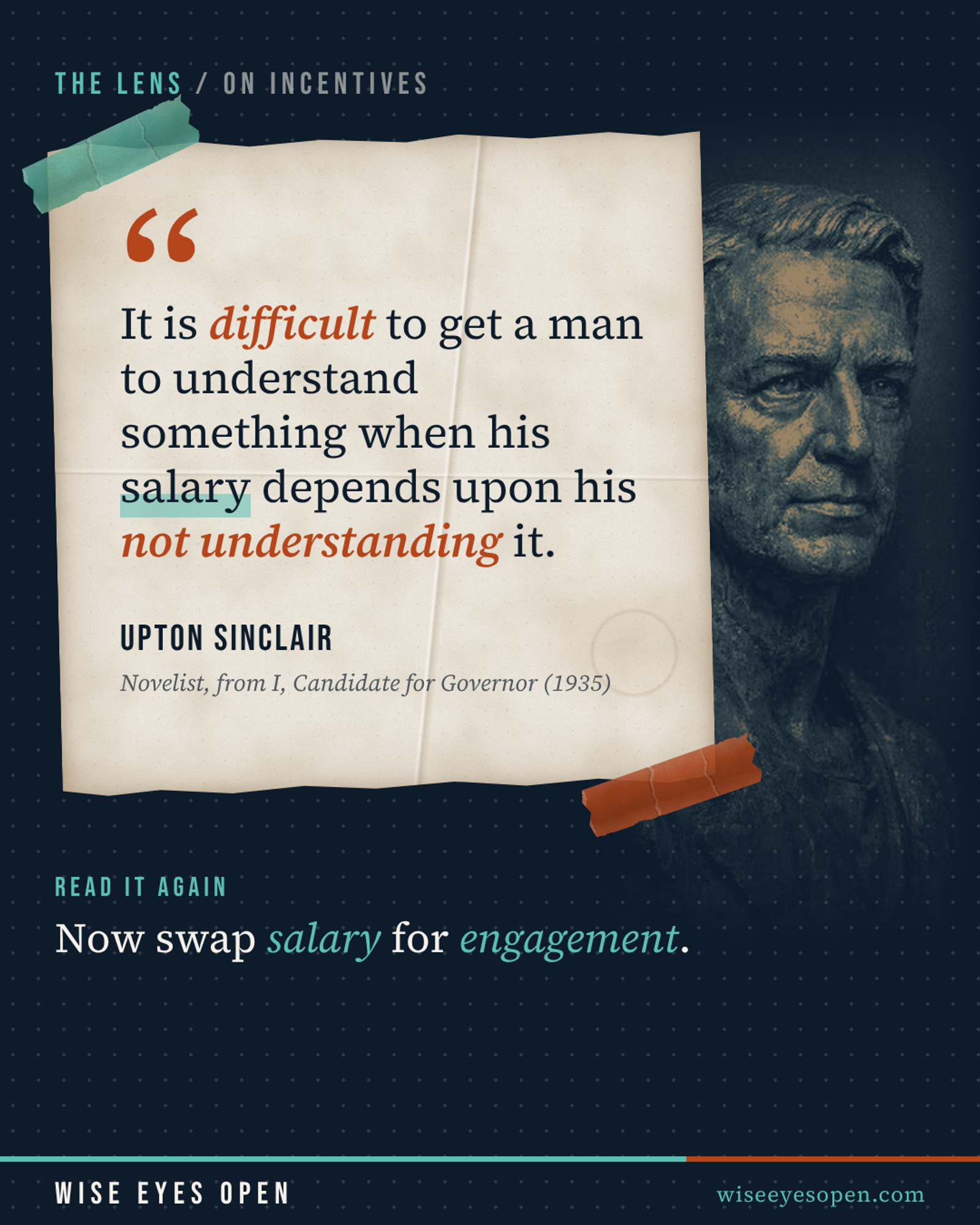
This isn't a conspiracy, and most of these people aren't villains. They're paying mortgages, running small agencies and building businesses. Upton Sinclair made the point nearly a century ago: it's hard to get someone to understand something when their salary depends on them not understanding it. Multiply that across hundreds of thousands of livelihoods and you get a culture that never quite gets round to changing.
I'm in this economy too. I'm publishing this on LinkedIn, sharing it from my phone and hoping an algorithm carries it to you. Nobody stands outside it.
Why the pleas keep failing
This is what makes the force so hard to see. There is no single enemy. There's no one company to regulate, no one boss to petition and no one villain to call out.
Instead there are millions of small, reasonable incentives, all pointing the same way. The screen repair shop. The café's Instagram. The WhatsApp rota. The sponsored morning routine. The agency campaign.
That's why advice from the top down keeps failing. A government report, a doctor's warning and a headteacher's letter all speak to us as individuals, then send us back into a world where every incentive around us pulls the other way. Willpower alone is outnumbered.
A decentralised problem needs a decentralised answer
This is also where it becomes hopeful. If the resistance is spread across millions of small relationships, so is the leverage.
We don't need to defeat the attention economy. We need to change the norms in the rooms we actually live in: the kitchen table, the team chat in the changing room, the pub, the friendship group, the cinema, the live music performance. The economics have no vote in those places, and the people around us carry more weight than any algorithm.
This is the idea at the heart of Wise Eyes Open: social self-regulation. We're far better at holding a line together than alone.
It can be two people agreeing that phones go away at dinner, a team agreeing quiet hours, or a group of friends putting their phones in the middle of the table. None of these takes on the phone economy head on. Each one simply carves out a small part of life where it doesn't apply, and it spreads the same way the problem does: person to person.
Nobody's paid to put it down. But we can agree to, together.
And when we do, something shifts. We find better balance and a shared etiquette. The advice our teachers, doctors and neuroscientists have been giving us for years finally has something to stand on. And we get back the space and clarity to build a world we can be proud of, and to live our lives to the full in it.